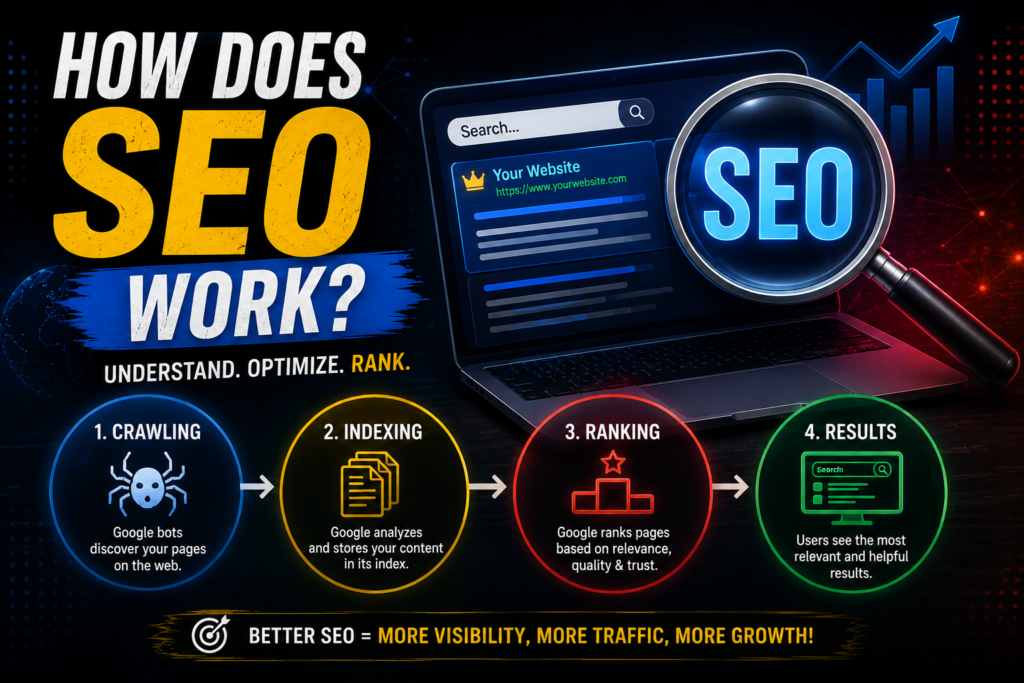
Whenever we search for something on Google, we usually click on one of the first few results. But have you ever wondered why some websites appear on the first page while others are not even visible?
This is where SEO comes in.
SEO stands for Search Engine Optimization. It is the process of improving a website so that search engines like Google can understand it better and show it to the right people.
In simple words, SEO helps Google understand what your website is about, how useful it is, and whether it deserves to appear in search results.
SEO may sound complicated in the beginning, but once you understand how Google works, it becomes much easier.
So, let’s understand how SEO actually works and how a website can rank on Google.
Quick Summary
Before going into detail, here is the simple process:
Search → Google Crawls → Google Indexes → Google Ranks → User Gets Results
SEO helps your website perform better throughout this process.
Now let’s understand each step.
What Happens When You Search on Google?
Imagine you search on Google:
“Best digital marketing course for beginners”
Google doesn’t randomly choose websites and put them on the first page.
It has to find relevant pages, understand their content, and decide which results are most useful for your search.
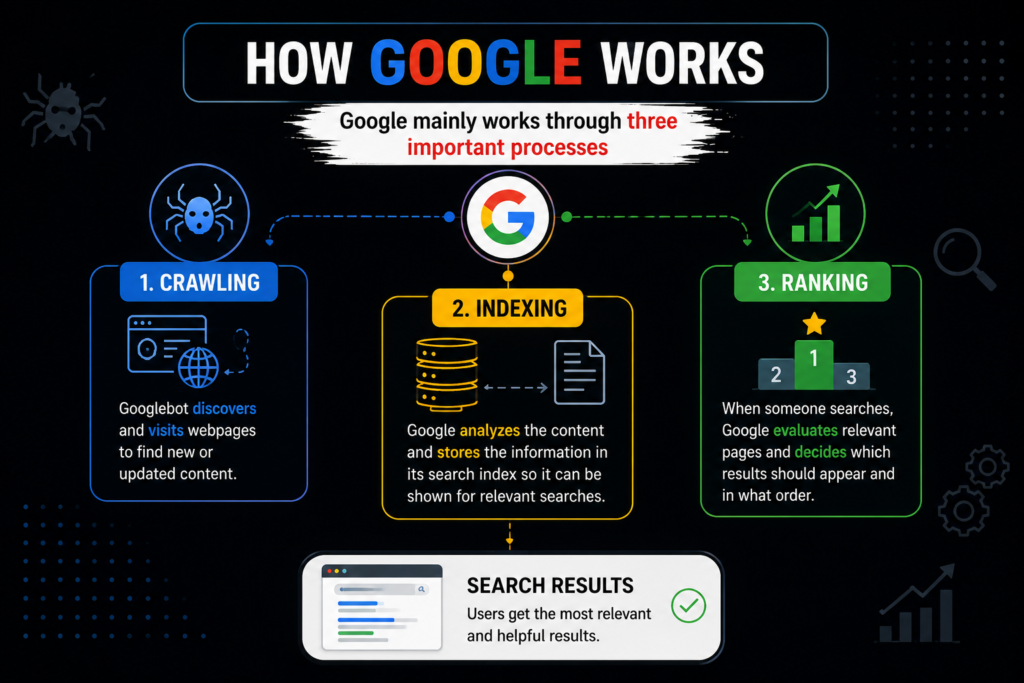
Google mainly works through three important processes:
Crawling
Indexing
Ranking
These three steps are very important for understanding SEO.
1. Crawling: Google Finds Your Website
The first step is crawling.
Google uses automated programs called Googlebot to discover and visit webpages.
You can think of Googlebot like a little explorer that goes around the internet and discovers new and updated pages.
For example, if you publish a new blog about SEO, Googlebot may visit that page and read its content.
It can also discover pages through links from other webpages.
So, if Google cannot properly access or crawl your website, it can become difficult for your pages to appear in search results.
This is why technical SEO is important.
2. Indexing: Google Understands and Stores Your Content
After crawling a webpage, Google needs to understand what that page is about.
This process is called indexing.
Google analyzes different parts of your webpage, such as:
Text
Headings
Images
Keywords
Links
Main topic
Overall page information
If Google is able to understand and index your page, it can consider that page when someone searches for a related topic.
Think of Google’s index like a huge library.
Your website is one of the books in that library.
If your book is properly organized and categorized, it becomes easier to find when someone searches for that topic.
3. Ranking: Google Decides Which Results to Show
Now comes the most important part — ranking.
When someone searches for something, Google has many possible webpages it could show.
So Google uses many different signals to decide which pages should appear higher in the search results.
These can include things like:
Relevance
Helpful content
Website quality
User experience
Page speed
Links and authority
Search intent
Mobile-friendliness
This is why simply adding keywords to a webpage is not enough.
Your content needs to actually help the person who is searching.
What Are Keywords in SEO?
Keywords are the words or phrases people type into search engines.
For example:
“best digital marketing course”
“how to learn SEO”
“SEO tips for beginners”
These are all examples of keywords.
Keyword research helps you understand what your target audience is searching for.
Once you know the right keywords, you can create content around those topics.
But there is one thing to remember:
Don’t just write for Google. Write for people first.
If your content is useful for users, easy to understand, and relevant to their search, it has a better chance of performing well.
Search Intent Is Also Important
Another important part of SEO is search intent.
Search intent simply means understanding why someone is searching for something.
For example, if someone searches:
“What is SEO?”
They probably want information.
If someone searches:
“SEO tools”
They may be looking for tools.
If someone searches:
“Buy SEO course”
They may have a buying intention.
So, before creating content, you should understand what the user actually wants.
If your content matches the user’s intent, it becomes more useful and relevant.
On-Page SEO
On-page SEO means optimizing the things that are present on your website.
Some important elements include:
Title tag
Headings
Keywords
Meta description
Content
Images
Internal links
URL structure
For example, if your blog is about “How Does SEO Work?”, your title, headings, and content should clearly communicate that topic.
This helps both users and search engines understand your page.
Technical SEO
Technical SEO focuses more on the technical side of your website.
It helps search engines crawl and understand your website properly.
Some examples include:
Website speed
Mobile-friendliness
Website security
Crawlability
Proper site structure
XML sitemap
Fixing broken links
You can have amazing content, but if your website is extremely slow or difficult for search engines to crawl, it can affect your SEO performance.
So, content and technical SEO both matter.
Off-Page SEO
SEO is not only about what happens on your own website.
Off-page SEO focuses on activities outside your website that can help build its authority.
One of the most common examples is backlinks.
A backlink is a link from another website to your website.
For example, if another trusted website mentions your blog and links to it, that can be a useful signal.
However, quality matters more than simply getting a large number of links.
The goal should be to build genuine authority rather than collecting random backlinks.
Why Is Quality Content Important?
One of the biggest parts of SEO is content.
You can use keywords, optimize your title, and work on technical SEO, but if your content does not provide value, users may not find it useful.
Good SEO content should:
Answer the user’s question
Be easy to understand
Provide useful information
Match search intent
Be well organized
Be updated when necessary
For me, this is one of the most important SEO lessons:
Don’t create content just because you want to rank. Create content because you want to help.
Ranking should be the result of providing value, not the only purpose.
Does SEO Give Instant Results?
No.
And this is one thing beginners should understand from the beginning.
SEO is a long-term strategy.
A new website usually cannot expect to rank on Google’s first page immediately.
It can take time to build content, authority, backlinks, and trust.
This is why consistency is very important.
You need to keep improving your website, creating useful content, analyzing your performance, and making changes when needed.
SEO is more like building a strong foundation than getting instant results.
How Can You Improve Your SEO?
If you are a beginner, don’t try to learn everything at once.
Start with the basics:
Step 1: Understand Your Audience
First, understand who you are creating content for.
Step 2: Find Relevant Keywords
Research what your audience is searching for.
Step 3: Create Helpful Content
Write content that actually answers their questions.
Step 4: Optimize Your Website
Work on titles, headings, URLs, images, internal links, speed, and mobile experience.
Step 5: Build Authority
Focus on creating valuable content and earning quality backlinks naturally.
Step 6: Track Your Results
Check your rankings, organic traffic, clicks, and other important SEO metrics.
Then improve your strategy based on the data.
Why Do I Think SEO Is Important?
In my opinion, SEO is one of the most useful digital marketing skills because it focuses on long-term growth.
You are not just paying for visibility.
You are building a website that can attract people through organic search over time.
It also helps you understand your audience better.
When you research keywords and search intent, you learn what people actually want.
And when you create content around those needs, you are not only improving SEO — you are also building a relationship with your audience.
Conclusion
So, how does SEO work?
The simple answer is:
Google discovers your website, understands your content, and decides where it should appear based on many different signals.
SEO helps you improve your website throughout this process.
From keyword research and quality content to technical SEO, backlinks, and user experience, every part has its own role.
But remember, SEO is not about finding a shortcut to the first position on Google.
It is about creating a website that is useful, relevant, trustworthy, and easy to understand.
SEO takes time, but if you stay consistent and focus on providing value, it can become a powerful source of long-term organic traffic.
And that’s exactly why I think SEO is worth learning.
Call To Action
Now that you know how SEO works, it’s time to put the knowledge into practice. 🚀
Start with one topic, find the right keywords, create useful content, and keep improving your website.
What do you think is the most important part of SEO — Keywords, Content, or Backlinks?
Let me know your answer!
And if you want to learn more about SEO and digital marketing in simple language, keep following for more practical content.
Learn. Apply. Grow. 🚀